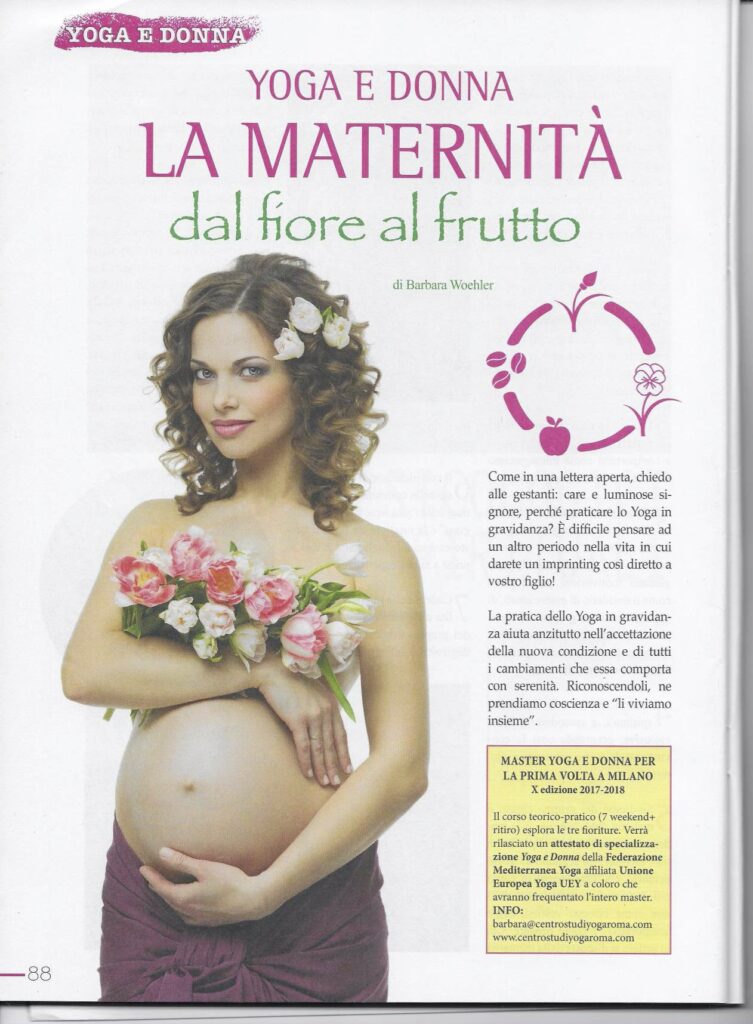
As in an open letter, I ask expectant mothers: “Dear radiant ladies, why practice yoga during pregnancy?”
It’s hard to think of another moment in your life when you will imprint so directly on your child.
First and foremost, the practice of yoga in pregnancy helps in the acceptance of the new condition and all the changes it brings with serenity. By acknowledging them, we become aware of them and ‘stay with it’.
This process, combined with mindful breathing, opens the door to a subtle inner journey, guiding us from the external world into our inner selves.
During pregnancy, all the senses are heightened: smell, touch, hearing, taste. If listened to, they speak of the baby’s presence within.
By working with inward-directed, centripetal feminine energy of being, of listening, of inner awareness, a loving relationship is developed with the child, who grows according to their own timing and manners. This is one of the primary goals of practicing haṭha yoga during pregnancy.
Nowadays, however, everything seems to move in the opposite direction, given the increasing demands of daily life.
Moreover, the due date marks time, compressing it into a whirlwind of “things to do.”
How many opportunities are there, really, to turn inward, to stay in continuous contact with this new reality?
The end of pregnancy often arrives sooner than expected, so it’s essential to seize this opportunity to process the profound journey of becoming a parent.
The need for more rest, especially in the first and third trimesters, is not a whim. Rather, it reflects a deep respect for the child who is making their presence known, aligning with ahiṃsā, the observance of non-harming. Likewise, a pregnant woman’s need to slow down or ask for help while carrying a heavy belly is not a sign of weakness. It’s an expression of immense inner strength. The experience of needing to ask for help is often deeply difficult to acknowledge, let alone express. However, it can become a powerful resource once this conditioning is overcome. And this very shift is what brings a mother-to-be closer to the reality of the newborn to come who is a bundle of needs.
If the expectant mother remained, as in the rest of her life, fast-paced and efficient, she would be light years away from the slow, dependent reality of the newborn.
Just as a baby may be startled by a sudden, fast hand gesture, but not by the same movement done slowly.
It’s a matter of changing our point of view: to stop seeing everything solely through the lens of the ego (ahaṃkāra), which constantly places us at the center of the world and often causes mental turmoil and restlessness.
To embrace the reality that the child exists as other, to recognize them as separate from oneself, is one of life’s great lessons that our children offer us.
Pregnancy is not an absolute time, in which everything is automatically understood, processed, and assimilated.
In fact, the entire 40 weeks serve to prepare us for becoming parents. This isn’t always obvious, and often childbirth is mistakenly seen as the final goal, when, in truth, it’s only the beginning of parenthood. Fear of childbirth becomes the main reason many women begin to prepare for it.
From a deeper perspective, childbirth lasts only a limited amount of time and, ideally, is simply a transition from “inside” to “outside.” Thus, the entire pregnancy becomes a truly precious time that must be used wisely. Because for the rest of your life, you will remain the parent of that being who once lived “inside.” What is not processed during pregnancy will need to be faced afterward, but there is no going back.
As pregnancy progresses, inner perspectives shift, and so do leg circulation, digestion, the belly’s weight, and posture.
Acceptance of all these changes is fundamental and necessary.
Opening oneself to all of this is the essence of the upadeśāsana squatting pose; Pelvic flexibility and tone/relaxation of the perineum are addressed in baddha koṇāsana, the “butterfly” pose;
New psychophysical balances can be found in simpler poses like tādāsana or the more demanding vṛkṣāsana, the “tree”.
At birth, it’s hard not to experience the event as a miracle, but it’s precisely that sense of awe and sacredness that could be extended to one’s entire life, in line with saṃtoṣa, the principle of contentment. Yoga in maternity becomes a moment of focus, a way to deepen yoga as a whole.
Here are several testimonials of women who recall their experience:
Fiamma remembers Giulia, born in 1987:
“Listening, taking time, and giving meaning to every detail that, in a rushed life, might otherwise go unnoticed… All the details of pregnancy tell a story of love and life that is not banal but extraordinary … To have lived those moments with loving attention… having lived with loving attention those moments… when the slow and conscious breathing brought us back to the present moment, feeling at one with the creature in us. The rest disappeared.“
Gioia writes of her experience with Luke, born in 1992: “Learning respect and conscious observation toward my body in āsana was at the same time offering a gentle caress to the growing child, moving at his pace, speaking to him without words, but breathing, listening, throbbing in silence. (…) Yoga during pregnancy taught me how to be continually reborn; the ritual of wonder each time, awakening within me the sacredness of life as a gift.
At birth, it’s hard not to experience the event as a miracle, but it’s precisely that sense of awe and sacredness that could be extended to one’s entire life, in line with saṃtoṣa, the principle of contentment.
Prenatal yoga becomes a moment of focus, a way to deepen yoga as a whole.
Halina recalls Nelson, born in 1983: “I confess that yoga gave me what I wanted. I had a wonderful eight-hour labor. What I took most advantage of all the practice I learned and assimilated was relaxation. I felt like a wave of the sea coming in and going away with every blight of my labor … when my son as a child was agitated or couldn’t sleep then, we did relaxation together, they were moments of understanding and well-being. When he was older he himself would ask me to do relaxation … and the understanding remained the same.“
Halina recalls Nelson, born in 1983:
“I confess that yoga gave me what I wanted. I had a wonderful eight-hour labor. What I used most from everything I had learned and absorbed was relaxation.
I felt like a wave of the sea coming and going with each contraction…Later, when my son was agitated or couldn’t sleep, we would relax together. Those were moments of deep connection and wellbeing. As he grew older, he would ask to repeat the relaxation practice again… that connection never changed.”
Ilaria writes about Leonardo, born in 2011:
“The course was a special experience for me… it helped me feel and trust in the naturalness of childbirth, to believe in the strength and vital energy within both mother and child.”
Raffaella, mother of Leopoldo Luigi, born in 2012, shares:
“Yoga is the path to transform every potential pain into energy, gathering and directing our deep inner power toward positive horizons, a force that connects us to the divine.”
It is becoming a vessel for life to pass through us—though it does not belong to us.
Silvia, mother of Sara, born in 2010:
“Yoga helped me live my emotions and sensations with awareness, allowing them to surface into consciousness without judgment. During labor, the pain of contractions and the peaceful intervals in between can become an infernal whirlwind, where pain is compounded by fear of its return.
If this didn’t happen to me, it’s because I tried to recenter myself, focusing only on my breath and on the positive emotion of the life that was about to be born.”
Discovering the value of conscious breathing on both body and mind helps in welcoming physical changes, delicate emotional experiences and embracing a new spiritual dimension. Yoga sequences in pregnancy support relief from back pain, promote pelvic and perineal mobility, encourage abdominal breathing, and foster positive thinking.
You also learn positions, breathing techniques and mental attitudes suited to facilitate childbirth and postpartum recovery.
Yoga in maternity thus becomes a powerful tool, fully expressing its potential by touching every aspect of the woman, the couple and the child’s life. Through practice, one confidently welcomes the sacred task of becoming an ‘instrument’ (seva) in service to the continuation of life.
Online references: www.centrostudiyogaroma.com, News: collection of more than 50 testimonies on “Experiences of Yoga in Pregnancy.”